
PASIG CITY – The Development Academy of the Philippines (DAP), through its Center for Governance (CFG), is training 22 local government officials and staff to develop artificial intelligence (AI)-powered solutions to address real-world administrative challenges through its Course on Artificial Intelligence (AI) for Local Government Units (LGUs), which opened on September 15, 2026, at the DAP Building in Pasig City.
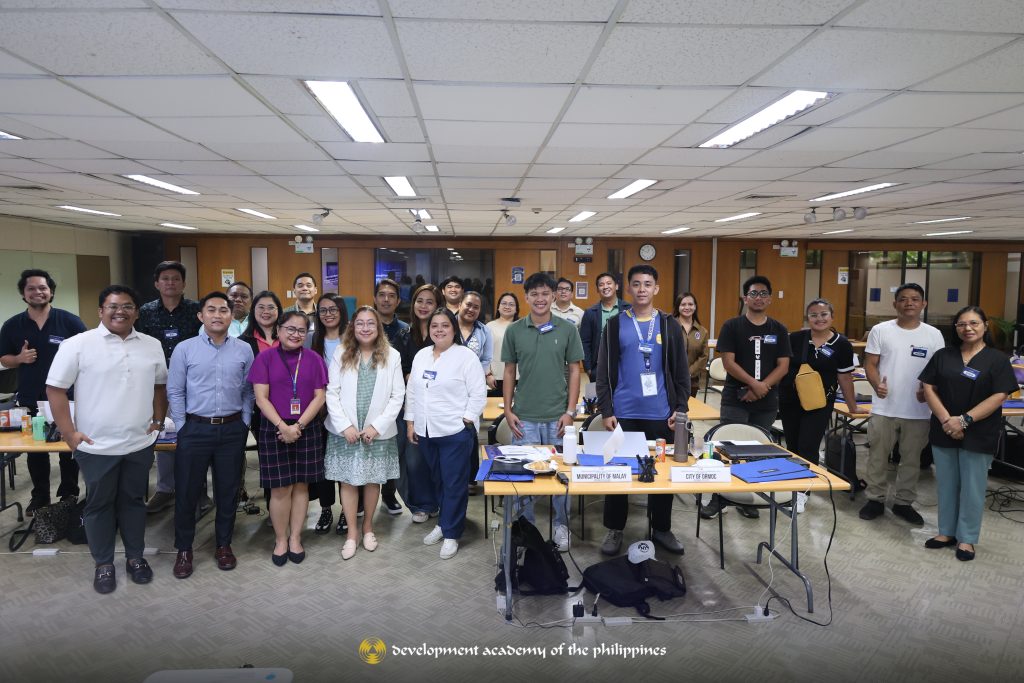
The four-day course brings together LGU department heads, key functionaries, and technical and legislative staff to build their capacity to integrate AI into local governance processes and systems and develop actionable solutions to operational challenges.
A key output of the course is an LGU AI-Powered Proof-of-Concept, through which participants will apply AI concepts and emerging tools to develop functional digital prototypes using no-code platforms and Vibe Coding. The prototypes are intended to address identified administrative bottlenecks in their respective LGUs.
DAP Center for Strategic Futures Director Armand Tristan R. Suratos challenged participants to look beyond basic AI adoption and focus on applications that can generate meaningful, high-impact public service improvements.
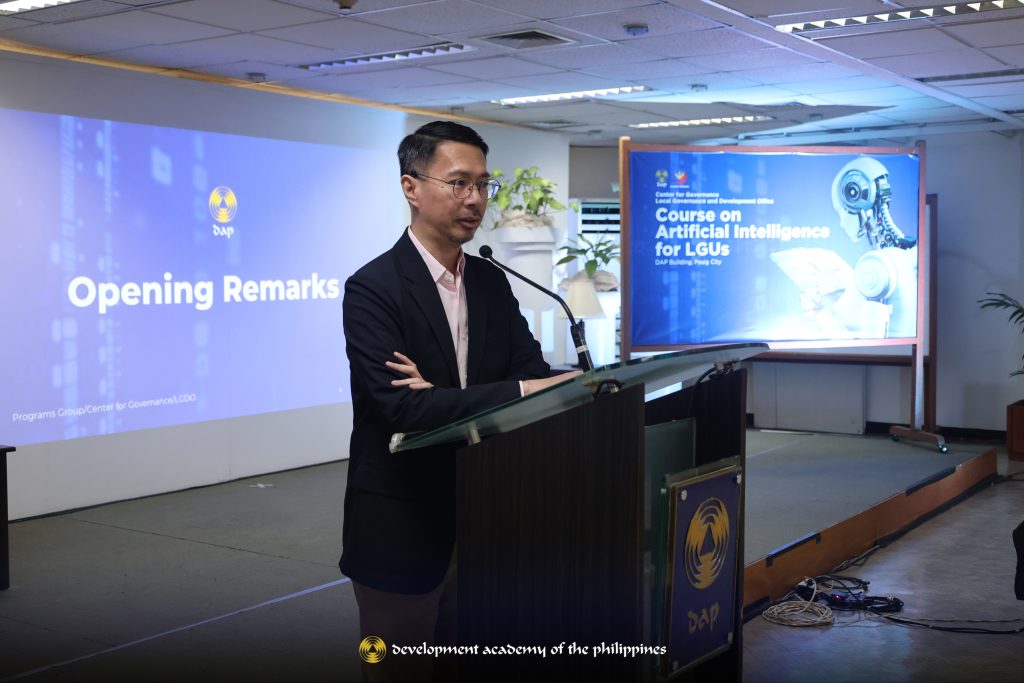
“The future of local governance is coming, and in many ways, it is already here. The question is not whether AI will become part of how the government works. The question is whether our LGUs will be ready to use it wisely, responsibly, and meaningfully. Learn boldly, ask difficult questions, experiment responsibly, and make this learning matter,” Director Suratos emphasized.
The opening sessions focused on building AI readiness in local administration. Former Department of Information and Communications Technology Undersecretary and Philippine ICT Innovation Networks Convenor Atty. Jocelle Batapa-Sigue discussed national AI governance frameworks and ethical guidelines, including safeguards against algorithmic bias, while DAP Project Manager Daniel G. Rosero introduced the core phases of the AI lifecycle and how automated workflows can improve routine municipal tasks.


The course also featured local government innovations during a peer-to-peer sharing session. Pasig City Transportation Development and Management Office Engineer Apryl Lalaine G. Siniel presented the city’s AI-powered infrastructure and traffic monitoring model, while Baguio City Government Chief of the Management Information and Technology Division Francis L. Camarao presented Project MINERVA (Monitoring of Indicators for Efficient Redevelopment and Value Assessment) as a case of technology-assisted governance.


Both projects received funding support from the Department of Science and Technology and the Department of Economy, Planning, and Development.
The succeeding sessions will focus on workflow analysis and AI integration, prompt engineering, and technical testing, as participants refine their AI-powered proof-of-concept prototypes to address identified local government challenges.